The three-card spread is the first thing most readers learn and the last thing they master. Past-present-future is the version everyone knows, and it is also the version that causes the most confusion, because it invites you to treat the cards as a forecast rather than as a description. Try a different framing. Card one: what the situation actually is, stripped of the story you have built around it. Card two: what you are contributing to it. Card three: what changes if you stop contributing that. Read left to right as a sentence, not as three separate verdicts. A Five of Pentacles next to the Hierophant next to the Eight of Cups is not three predictions — it is one argument about scarcity, institutions and walking away, and the argument only makes sense as a whole. When a card refuses to fit, resist the urge to consult a reference book mid-reading. Sit with the image. Ask what it is doing in this position rather than what it means in the abstract. The Tower in the third position of a spread about a stagnant job is not a catastrophe

Saturn takes roughly twenty-nine and a half years to travel the zodiac and return to the degree it occupied when you were born. That return lands somewhere between twenty-seven and thirty-one for most people, and it has acquired a reputation as an ordeal. The reputation is half-earned. What Saturn does is test structures. Anything you have built on a foundation that does not hold — a career chosen to satisfy somebody else, a relationship maintained by avoidance, a self-image assembled at nineteen and never revisited — comes under load. Structures that hold, hold. Structures that do not, come apart, and it is the coming apart that people remember. This is why two people can have wildly different returns. Someone who spent their twenties building deliberately often experiences it as consolidation: a promotion, a marriage, a house, a sense of having arrived somewhere on purpose. Someone who spent their twenties deferring experiences it as a reckoning arriving all at once. Where it lands in your chart matters more than the fact of it. Saturn returning in the seventh house puts the weight on partnership. In the tenth, on vocation and public standing. In the fourth, on home, family and what you inherited without agreeing to it. The practical advice is unglamorous: do not start anything during your return that you would not want to still be doing at forty. Saturn's gifts are slow, structural and permanent, and they are given to people who did the boring work. The second return, at fifty-eight or fifty-nine, asks whether you meant it.

A dream that returns is a dream that has not been answered. The content varies — teeth, water, the house with the extra room, the exam you did not study for — but the mechanism is consistent: something unresolved keeps generating the same image because the image has not yet done its job. The common mistake is to look up the symbol. Teeth mean anxiety about appearance, water means emotion, the exam means imposter syndrome. Sometimes. But a dictionary reading collapses the one thing that makes the dream useful, which is that it is yours and it is specific. Better questions: when did it start? What was happening that month? What is different about the nights it recurs? Does it end the same way every time, and what happens if you imagine it ending differently? The house with the extra room deserves special mention because it is nearly universal and almost always positive. You are moving through somewhere familiar and find a door you had not noticed, and behind it a whole wing you did not know you owned. People wake from it unsettled. They should not. It is generally a dream about capacity — something available to you that you have not counted. Keep a notebook by the bed and write in the first ninety seconds, before the narrative tidies itself. Record the feeling as well as the plot

Let us be straightforward, because the field is not always. A crystal is not medicine. It will not treat an illness, it will not replace a doctor, and anyone telling you otherwise is selling something at your expense. What a crystal is, reliably, is a physical anchor for an intention. That is not a small thing. Much of what makes a practice effective is consistency, and consistency is easier when it is attached to an object you can hold. A stone in your pocket that you touch when your chest tightens is a functioning reminder to breathe. That is real, and it does not require the stone to be doing anything on its own. Beyond that, the traditional correspondences are worth knowing because they carry centuries of accumulated association, and association is the working material. Amethyst for clarity and sleep. Rose quartz for self-directed kindness, which is harder than it sounds. Black tourmaline and obsidian for boundaries, which is why people reach for them before difficult conversations. Citrine for momentum. Selenite for clearing a space that feels stale. Practical care: rinse under running water unless the stone is soft or water-soluble — selenite dissolves, so do not. Moonlight overnight is a gentler charge than direct sun, which fades amethyst and rose quartz. Set the intention out loud when you first pick a stone up
Your life path number comes from your full birth date reduced to a single digit, with eleven, twenty-two and thirty-three held as master numbers. It describes disposition — the grain of the wood. Useful, but static, and static information has limited practical value. The personal year is the part people underuse. Add your birth month and day to the current calendar year and reduce. That gives you a number from one to nine, and it cycles: a nine-year arc that repeats across your life. A personal one year is for starting. Momentum is available and the things you begin tend to stick. A two year is slow and relational and frustrating if you were expecting one to continue. Three is expressive and scattered. Four is the grind — foundations, admin, the unglamorous work that makes years five through eight possible. Five brings change and restlessness, and it is a poor year for signing long contracts. Six is domestic and responsible. Seven turns inward, and it is the year people most often mistake for depression when it is actually a fallow period doing necessary work. Eight is harvest and money. Nine is ending, release, and clearing the ground. The practical use is matching effort to season. Launching a business in a nine year is swimming upstream. Waiting out a four year in frustration wastes the only year where foundations pour properly. Calculate the last ten years of your own and check them against what actually happened. Most people find the fit uncomfortable enough to keep reading.

Preparation matters more for a mediumship sitting than for most readings, and the preparation is mostly about expectation. Come with a general openness rather than a specific target. Sitters who arrive determined to hear from one particular person often leave disappointed, not because nobody came through but because they were listening past whoever did. Communication does not queue politely in order of emotional priority. Do not feed information. A good medium will ask you to hold your responses to yes, no, or I do not know, and will be explicit about it. This is not a trick — it is quality control that protects you. If a reader is asking leading questions and building on your answers, you are not getting evidence, you are getting a performance. Expect fragments. Evidential mediumship tends to surface small, oddly specific details — a nickname, a broken watch, a particular chair, a smell — rather than flowing paragraphs. The specificity is the evidence. Grand statements that would apply to anyone are not. Write things down or record if the reader permits it. Sitters routinely forget a third of the sitting within a day, and details that meant nothing in the moment often land a week later when a relative confirms them. Understand that not every sitting connects. Any medium claiming a hundred percent rate is not counting honestly. A reader who tells you today is not working and stops the session has more integrity than one who improvises to fill the time. Finally, grief is not a problem to be solved in an hour. A sitting can help. It is not a substitute for the slower work, and a decent reader will say so.

Distance reiki is the part of the practice that newcomers find hardest to accept, and the objection is fair: if the treatment normally involves hands, what is happening when the practitioner is four hundred miles away? In the tradition, the second-degree attunement includes a symbol specifically for sending across distance, on the principle that the connection is not dependent on proximity. Whether you accept that framing or not, the practical structure is the same in both cases: an agreed window, a receptive state, and attention. What makes a distance session work in practice is the agreement. You commit to twenty or thirty minutes where you are not doing anything else — not working, not scrolling, lying down somewhere you will not be interrupted. The practitioner commits to the same window. That protected, intentional rest is doing real work regardless of what you believe about energy. What people report is consistent enough to be worth noting: warmth in particular areas, heaviness, occasional emotional release, and usually deep sleep afterwards. Some feel nothing during the session and notice a shift over the following two days. A good practitioner sends you feedback afterwards — where attention gathered, what felt stuck — and it is worth comparing against your own experience without having read theirs first. Reiki does not treat disease and is not a substitute for medical care. It is well-suited to stress, sleep, recovery periods and the stretch after a loss where you are functioning but depleted. Pitched at that, it holds up.
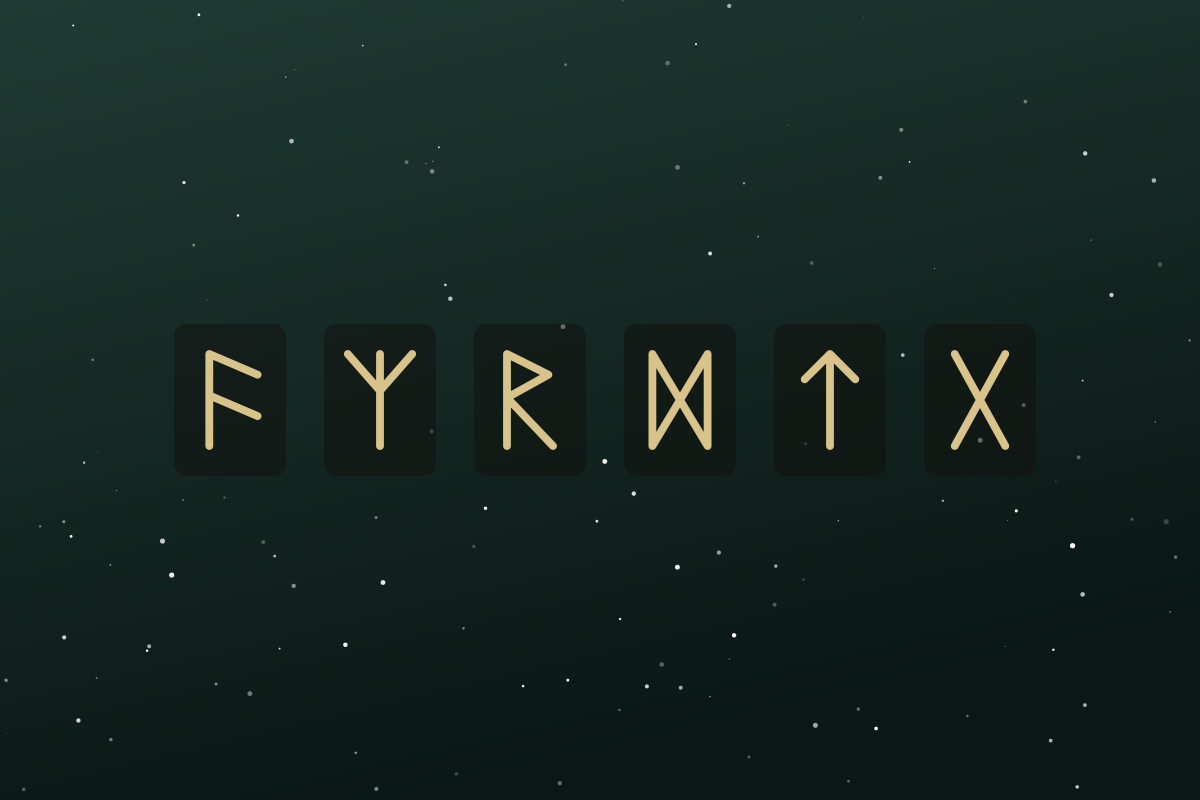
The Elder Futhark is twenty-four characters, and unlike tarot there is no illustrated scene to lean on. You get a mark and a name and whatever tradition has attached to it. This makes runes harder to bluff and, for many people, easier to trust. Start with a three-rune draw, blind, from a bag. Situation, obstacle, advice. Resist the urge to draw more when you dislike the answer